
Iron & Wood Combination Fencing in Houston, TX
Iron & Wood Combination fencing pairs a fabricated metal frame with wood infill to combine defined privacy and a strong architectural outline. Many modern “iron and wood” fences use welded or fabricated steel rather than traditional wrought iron, so metallurgy and finish should be confirmed. The result can be distinctive and customizable, but it carries two separate maintenance programs: protect the steel finish and care for the wood.
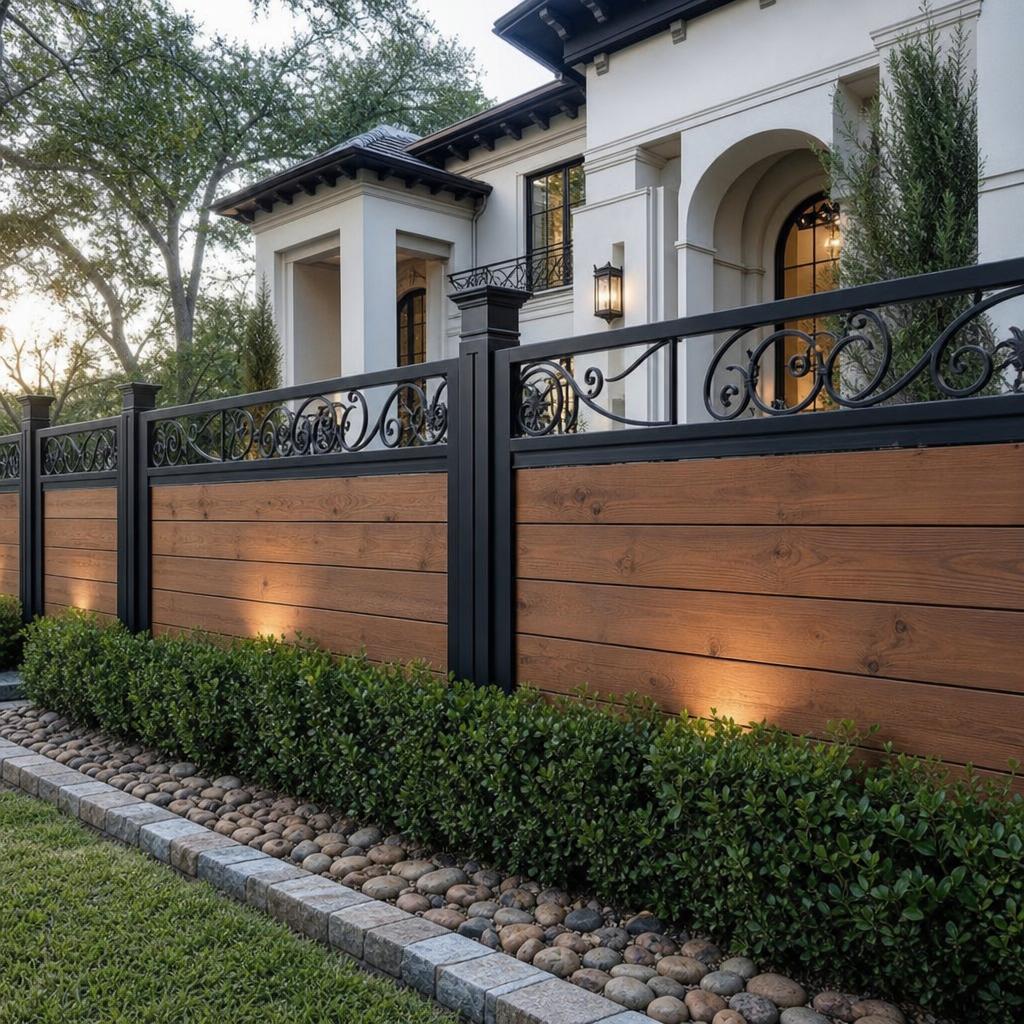
What Is an Iron & Wood Combination Fence?
This mixed-material fence uses steel posts and rails—often welded or shop-fabricated—with boards or panels attached as the infill. Cedar or pressure-treated pine may be selected where supported, and the boards can run horizontally or vertically. Traditional wrought iron is a historically distinct material and should not be used as a catch-all label: many current projects marketed as “wrought iron and wood” are modern fabricated steel. The quote should identify the frame material, welds, corrosion-protection finish, wood species or product, fasteners, and gate construction.
- The steel frame supplies the visual outline and structural support; wood supplies screening and texture.
- Board spacing, thickness, orientation, cap details, and stain color shape the finished appearance.
- A mixed system requires compatibility between board attachment, frame movement, drainage, and gate weight.
Is an Iron & Wood Combination a Good Fit for Houston?
Houston's sun, humidity, heavy rainfall, and storms affect the two materials differently. Water management, post foundations, and a sound frame matter, while wood infill needs space and finish choices suited to outdoor exposure. A damaged steel coating may allow corrosion to begin; unsealed or poorly drained wood may weather, split, or decay sooner. The local site review should consider sprinklers, grade, drainage, tree contact, wind exposure, access, property lines, and whether HOA rules permit the height and street-facing design. A coating and stain are not substitutes for correct fabrication and installation.
- Keep wood clear of persistent soil or standing water and provide practical drainage details.
- Plan inspection access around welds, fasteners, gate hardware, and the lower board edges.
- Verify local, HOA, pool, and gate requirements before finalizing a custom design.
Advantages of Iron & Wood Combination Fencing
Things to Consider
Iron & Wood Combination vs. Cedar vs. Ornamental Steel
| Factor | Iron & Wood Combination | Cedar | Ornamental Steel |
|---|---|---|---|
| Privacy | Strong with close infill | Strong in privacy layouts | Usually open sightlines |
| Appearance | Custom metal-and-wood contrast | Natural, warm, and adaptable | Decorative metal profiles |
| Maintenance | Two separate material routines | Wood finish and board care | Steel finish and corrosion inspection |
| Strength | Frame strength plus wood screening; design-dependent | Wood framing and posts; design-dependent | Metal-focused structure; design-dependent |
| Initial cost | Often premium due to fabrication | Value to premium by species and design | Premium, especially when custom fabricated |
| Repairability | Boards can be targeted if frame is sound | Boards and rails can be replaced | Metal parts may require fabrication or section work |
| Privacy upkeep | Wood finish remains part of ownership | Periodic finish timing depends on exposure | No wood infill, but finish still needs inspection |
Choose the combination when privacy and a designed metal-and-wood appearance justify maintaining both materials. Cedar is simpler and more uniformly natural; ornamental steel is better suited to open visibility, decorative metal, or a single-material maintenance plan.
Iron & Wood Combination Styles
Vertical boards create a familiar privacy profile, while horizontal boards can produce a cleaner contemporary line when the frame and attachment details support it. Cedar and pressure-treated pine are possible infill directions where the selected installer and system support them; species, board thickness, spacing, and finish should be written into the scope. Options may include framed privacy panels, alternating open-and-solid sections, cap rails, contrasting frame colors, and coordinated pedestrian or driveway gates. Do not assume every provider builds every custom pattern.
What Affects Iron & Wood Fence Pricing in Houston?
Pricing reflects linear footage, height, steel post and rail dimensions, welded versus assembled fabrication, finish or powder-coating process, wood species and board thickness, orientation and spacing, cap or trim details, foundation requirements, corners, gates, gate width and hardware, demolition, access, grade, utilities, drainage, and installation complexity. Custom drawings, difficult welding access, heavier gate frames, specialty stains, and matching an existing design can add scope. HOA review or permit requirements may also affect timing and coordination. A material name alone is not enough to compare two quotes.
Iron & Wood Combination Installation Considerations
The installer should establish the fence line and utilities, size post foundations for the site, fabricate or assemble the steel frame, protect welds and cut edges, and attach the wood without trapping avoidable moisture. Frame alignment affects board lines, gate clearances, and the finished appearance. Wide gates need posts, hinges, bracing, and latches selected for their actual weight and use. The selected wood should be checked for moisture, grade, dimensions, and finish requirements. Installation should follow the chosen system's fabrication details and account for grade, drainage, access, and manufacturer or coating instructions where applicable.
How Do You Maintain a Two-Material Fence?
Treat the frame and infill as separate maintenance tasks. Wash away dirt and organic buildup, inspect steel coating for scratches, bubbling, exposed metal, and weld-area damage, and use a compatible touch-up process when appropriate. Inspect boards for checking, splitting, cupping, rot, loose fasteners, and finish wear; clean and reseal or restain according to the wood product, exposure, chosen appearance, and finish guidance. Keep vegetation from holding moisture against either material, and check gate alignment, hinges, latches, and bottom clearances after severe weather. A mixed fence is lower effort only when both sides receive attention.
How Long Does an Iron & Wood Combination Fence Last?
There is no single lifespan for a mixed-material fence because the steel frame and wood infill age on different paths. Service life depends on steel thickness and finish, weld and foundation quality, wood species and exposure, drainage, UV and moisture, fasteners, storm or impact damage, and maintenance. A sound frame may outlast individual boards, making section replacement practical; conversely, corrosion or foundation movement can require structural work. Any numeric estimate should be treated as a project-specific expectation, not a guarantee.
Who Is Iron & Wood Combination Fencing Best For?
This material can suit an owner who wants strong privacy, a custom architectural statement, and the contrast of wood with a fabricated metal frame—and who accepts premium fabrication and two maintenance routines. It may be a poor fit when the lowest initial cost, a simple single-material care plan, or quick standardized repairs is the priority. Cedar can be more straightforward for a natural wood look; ornamental steel can make more sense when open visibility and metal-only detailing matter.
What Do I Need for an Iron & Wood Fence Quote?
- Property address, approximate footage, desired height, grade, access, and existing-fence removal.
- Frame terminology and specification: fabricated steel or another metal, post and rail profile, weld/fabrication preference, and finish.
- Wood infill species or product, board orientation, thickness, spacing, cap or trim, and stain or finish preference.
- Number, width, location, and intended use of gates; include hinge, latch, automation, or reinforcement needs.
- Photos, survey or property-line information, HOA requirements, drainage concerns, and desired project timeline.
Ready to price Iron & Wood Combination fencing?
Share the property, layout, gates, finish preferences, and site conditions so participating providers can evaluate the request.
Frequently Asked Questions
Is an iron-and-wood fence actual wrought iron?
Not necessarily. Many modern projects use fabricated or welded steel framing rather than traditional wrought iron. Ask the installer to identify the actual metal, fabrication method, and protective finish in the scope.
Does the steel frame rust?
Steel can corrode when its protective coating is damaged or moisture remains against exposed metal. Powder coating, paint, galvanizing, compatible touch-up, drainage, and inspection can affect corrosion performance but do not make every frame rust-proof.
What wood is used for the infill?
Cedar and pressure-treated pine are possible choices where the selected system supports them. Species, grade, board thickness, orientation, moisture condition, and finish should be specified rather than assumed.
Does the wood still need staining or sealing?
Usually, owners should plan for wood-specific cleaning and finish care. Timing depends on the species, product, exposure, moisture, finish, and desired appearance; the metal frame does not remove that obligation.
Can individual boards be replaced?
Often, individual boards or a section can be replaced when the frame and attachment points remain sound. Matching dimensions, stain, color, and weathering may be more difficult over time.
Is it more expensive than a normal wood fence?
It often costs more because it combines fabricated metal framing, foundations, wood infill, finishing, and custom gates. Footage, height, design, materials, access, and site work determine the actual comparison.
Can it be built with horizontal boards?
Horizontal infill is possible in many custom designs, but board span, attachment, frame spacing, drainage, and gate transitions need to be planned for the selected materials.
How are combination-fence gates reinforced?
The gate frame, hinges, latch, posts, and bracing should be selected for the gate's dimensions, infill weight, and daily use. A coordinated design should not rely on decorative appearance alone; ask for the structural gate scope.